
Full Swing Simulator Accuracy vs Real Course
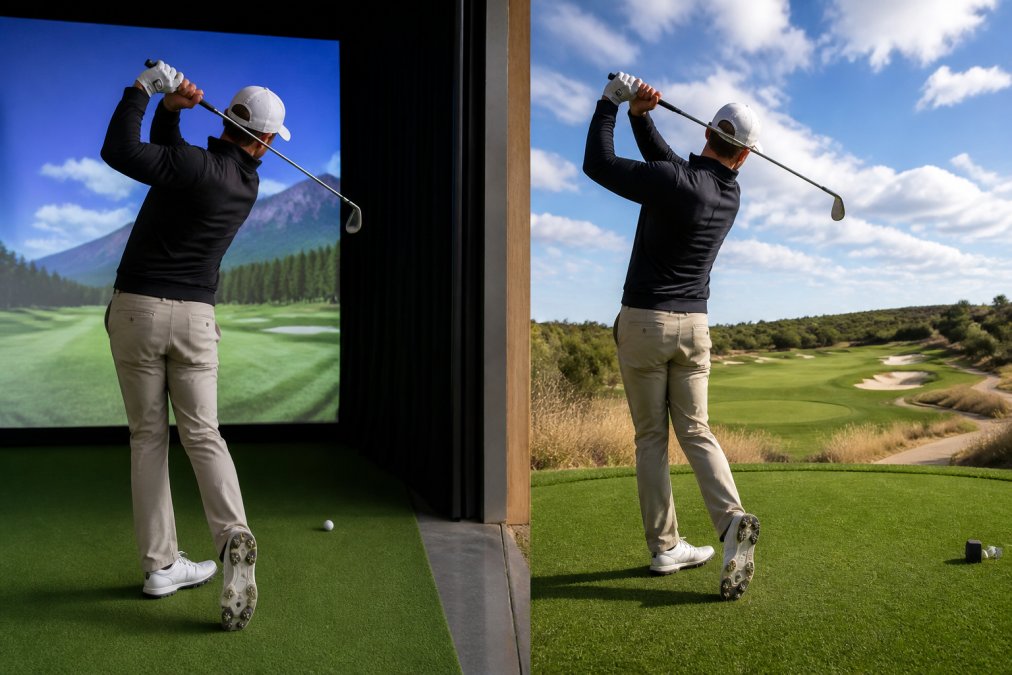
Table of Contents
- Full Swing Simulator Accuracy: What the Technology Actually Measures
- Golf Simulator vs Real Course Distance: Why Numbers Differ
- Full Swing Simulator Ball Flight Data and What It Tells You
- Indoor Golf Practice Benefits for Your Real Game
- Environmental Factors: What Simulators Can't Replicate
- How to Use Simulator Data to Improve Your On-Course Performance
- Frequently Asked Questions
Last Updated: September 27, 2026
Full Swing Simulator Accuracy: What the Technology Actually Measures
Full swing simulator accuracy vs real course performance is a question every golfer asks before committing to indoor practice. At Open Tee Golf, we understand exactly what simulators measure and where the gaps exist. The technology tracks ball flight with impressive precision, but "accurate" doesn't mean identical to real-world conditions. Understanding the difference matters because it changes how you interpret your data and train effectively.
Modern Full Swing simulators use high-speed cameras and infrared sensors to capture launch angle, ball speed, spin rate, and direction within milliseconds of contact. The system then calculates distance based on these inputs using algorithms that account for standard atmospheric conditions. For most golfers, this data is remarkably reliable when compared to launch monitor readings on an actual range.
The key insight: simulators measure mechanics with high fidelity. They capture what your swing actually produced. What they don't capture is how those mechanics will perform under real course conditions with wind, elevation changes, firmness variations, and the psychological pressure of live play.
Golf Simulator vs Real Course Distance: Why Numbers Differ
Your simulator shows a 185-yard carry. You hit the same club on the course and it lands at 175 yards. This is frustrating, but it's also predictable.
Simulators calculate distance using standardized atmospheric conditions: sea level, 70-degree temperature, 50% humidity, no wind. Real courses rarely match this baseline. A course at elevation plays shorter. Cold air is denser and reduces carry. Wind either adds or subtracts yardage depending on direction. Firmness of the ground affects roll-out significantly, a ball that carries 180 yards on a simulator might roll an additional 15 yards on a firm fairway or just 5 yards on soft ground.
The simulator also assumes optimal strike conditions. It doesn't account for the occasional thin contact, the slight mis-hit you didn't fully feel, or the reality that your actual course swing sometimes produces different results than your range swing. Many golfers swing differently under pressure, which changes ball flight characteristics that simulators can't predict.
Here's what matters: the relative differences in your simulator data are accurate. If a 7-iron produces 10 more yards than a 6-iron in the simulator, that relationship holds true on the course. The absolute distance numbers are useful for club selection, but you should expect real course distances to run 5-10 yards shorter on average, depending on conditions.
PGA Tour launch monitor data standards show that professional-grade simulators like Full Swing achieve within 2-3% accuracy for ball speed and launch angle measurements. That precision is real. The distance variance comes from environmental factors, not measurement error.
Full Swing Simulator Ball Flight Data and What It Tells You
The ball flight data displayed on your Full Swing simulator is where the real value lives for improvement. Launch angle, ball speed, spin rate, and axis of rotation directly correlate to what happens on the course. These numbers tell you whether your swing is producing the mechanics you intend.
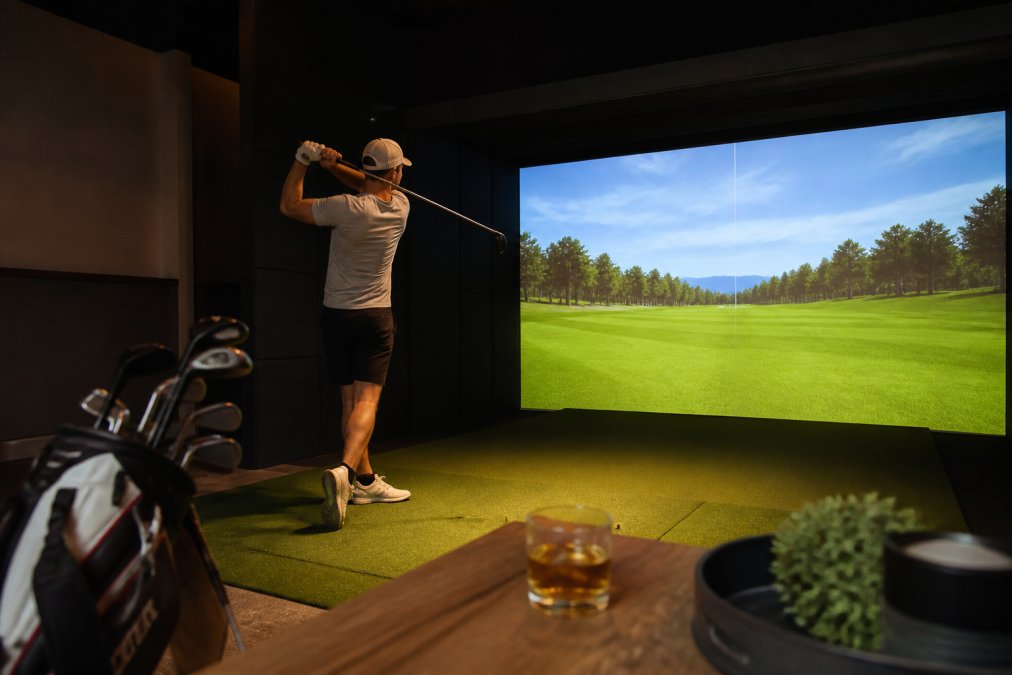
Launch angle is the angle at which the ball leaves the club face. For most golfers, optimal launch angles range from 12-18 degrees depending on club and swing speed. If your simulator shows a 25-degree launch with a driver, you're hitting up on it too much, the ball will balloon and lose distance. If it shows 8 degrees, you're hitting down too steeply. The simulator catches this immediately. On a real range, you might not notice for several shots.
Ball speed is straightforward: how fast the club is moving the ball off the face. This correlates directly to distance potential. Improving ball speed means improving swing efficiency, which translates to real course gains. Tracking ball speed over weeks of practice gives you concrete feedback on whether your training is working.
Spin rate matters more than most golfers realize. Too much spin with a driver causes ballooning and lost distance. Too little spin with irons causes the ball to bounce unpredictably. The simulator shows you exactly where you stand. Many golfers discover through simulator data that they're spinning the ball more than optimal, which explains why their distances don't match their expectations.
The axis of rotation, the direction the ball is spinning, reveals swing path issues. If your axis is tilted, you're imparting sidespin, which curves the ball. The simulator shows this immediately. Real course feedback takes multiple shots to confirm the pattern.
This data is actionable because it's immediate and consistent. You can make a swing change and see the result in the next shot. That feedback loop accelerates learning compared to outdoor practice where variables cloud the picture.
Indoor Golf Practice Benefits for Your Real Game
The benefits of indoor golf practice extend beyond the data. The controlled environment removes obstacles that prevent focused training.
No tee times means you practice when you want, not when the course permits. No waiting for groups ahead removes the mental frustration that often derails practice sessions. No weather interruptions let you build routines during off-season months when outdoor golf is impossible. These factors matter more than they sound. Consistent, uninterrupted practice produces faster improvement than sporadic outdoor sessions interrupted by weather, crowds, and scheduling constraints.
Many golfers in Wyoming and the surrounding area use Open Tee Golf's 24/7 access to maintain swing consistency year-round. The repetition and consistency compound over time.
The private bay environment also removes social pressure. You can work on a weakness without an audience. You can take multiple swings at the same shot to test a change. You can video your swing and analyze it without feeling rushed. This psychological safety accelerates learning because you're not performing, you're practicing.
Temperature control matters more than most golfers realize. Your swing mechanics change when you're cold or overheated. A climate-controlled bay lets you focus on technique rather than managing discomfort. This is particularly valuable for shift workers or early-morning practitioners who might otherwise be fighting weather conditions.
Environmental Factors: What Simulators Can't Replicate
Understanding simulator limitations helps you interpret data correctly and prepare for real course performance.
Wind is the most obvious omission. A simulator can't simulate wind gusts, direction changes, or the mental adjustment required to compensate. On the course, a 10-mile-per-hour crosswind changes club selection and swing thought. The simulator has no wind, so this skill develops only through outdoor practice.
Elevation changes affect both distance and ball flight. Uphill shots require different swing mechanics than level shots. Downhill lies force adjustments to balance and swing plane. Simulators play every shot from a level stance. If your home course has significant elevation changes, you'll need outdoor practice to master those conditions.
Firmness variation matters for approach shots and short game. A ball landing on firm fairway ground rolls significantly more than the same shot on soft ground. Simulators assume standard turf conditions. Real courses vary by season, weather, and maintenance. This is why your simulator approach distances don't always match real results.
Psychological pressure doesn't exist in a simulator. You're not nervous on the final hole of a tournament. You're not frustrated by a bad previous shot affecting your next swing. You're not playing for a specific score that matters. These mental factors change how golfers swing. Simulator practice can't replicate this, but it can build mechanical consistency that holds up under pressure.
Green reading is absent from simulators. You see the putt line on screen, but you don't develop the real-world skill of reading slopes, grain, and break. Putting simulators have improved, but they still don't fully replicate the judgment required outdoors.
The simulator advantage is precision feedback on mechanics. The real course advantage is environmental complexity and psychological realism. Both are necessary for complete golfer development.
How to Use Simulator Data to Improve Your On-Course Performance
The gap between simulator data and real course results closes when you use the data strategically.
Start with ball speed consistency. If your ball speeds vary by 5+ mph shot to shot, your swing mechanics are inconsistent. Focus on repeating the same swing feel until ball speed stabilizes within 2-3 mph.
Frequently Asked Questions
How accurate are Full Swing simulators compared to real golf courses?
Full Swing simulators use advanced camera and sensor technology to capture club data, ball speed, launch angle, and spin rate with high precision. The simulator then calculates ball flight and landing based on physics models. For controlled metrics like swing mechanics and shot shape, accuracy is excellent. However, simulator distance can differ from real course distance by 5-15 yards depending on environmental conditions, course elevation, and turf firmness, factors the simulator estimates rather than measures directly.
Why does my simulator distance differ from my outdoor distance?
Simulators estimate distance using ball speed, launch angle, and spin rate. Real courses add variables: wind direction and speed, air density, ground elevation, slope, and turf firmness. A 150-yard shot on a simulator might play as 140 yards outdoors into the wind, or 165 yards downhill with firm fairways. The simulator's physics model is accurate, but it cannot measure the specific conditions on the day you play. Treat simulator distance as a baseline; real course distance depends on weather and course setup.
Are indoor golf simulators good for improving your real-world game?
Yes, simulators excel at improving swing mechanics and consistency. You get immediate feedback on club path, face angle, and ball flight, data that helps you identify and fix flaws. The challenge is that simulators remove environmental pressure: wind, gallery noise, and course management decisions. Use simulator practice to refine technique, then test those improvements on the course. Many competitive golfers use simulators for off-season skill work and course play for validation and scoring practice.
Do golf simulators account for wind and environmental conditions?
Full Swing simulators do not measure real wind or weather. They use preset environmental conditions or allow you to input estimated wind speed and direction. The simulator then adjusts ball flight based on your input. This is useful for practicing wind management, but the adjustment is calculated, not measured. Real course wind varies across the fairway, changes throughout the day, and affects different shots differently. Simulators teach you how to think about wind; real courses teach you how wind actually behaves.