
How to Improve Golf Swing Speed: 7 Steps for 2026

Table of Contents
- What You'll Need Before You Start
- Step 1: Build a Foundation with Strength and Conditioning
- Step 2: Master Swing Tempo and Rhythm
- Step 3: Use Overspeed Training for Golf to Break Speed Plateaus
- Step 4: How to Use Launch Monitors for Speed Training
- Step 5: Practice Golf Swing Speed Training Drills
- Step 6: Warm Up for Speed and Prevent Injury
- Step 7: Track Your Progress with Data
- Frequently Asked Questions
Last Updated: September 25, 2026
What You'll Need Before You Start
Golf swing speed is the measurable rate at which your clubhead travels through impact, and it drives how far the ball carries. This guide from Open Tee Golf breaks the process into seven steps you can work through indoors, year-round.
Before you chase raw speed, gather a few basics:
- A launch monitor or simulator that reads clubhead speed and ball speed
- A strength plan you can follow twice a week
- A tempo routine to keep your swing in sync
- Overspeed clubs or a weighted training aid
- A warm-up sequence you do before every session
- A simple log to track numbers over time
Most golfers skip straight to swinging harder. That is the single biggest mistake. Speed comes from a chain of movements: your legs push into the ground, your hips rotate, and that energy travels up through your core into your arms and the club. Break one link and the whole chain leaks speed.
The Titleist Performance Institute's swing research has long emphasized that mobility and stability come before power. Get those in place first, then add speed.
Step 1: Build a Foundation with Strength and Conditioning
Strength training builds the base for a faster swing. You do not need to become a powerlifter. You need a strong lower body, a stable core, and a resilient back, and you need to train them in the order your swing actually uses them.
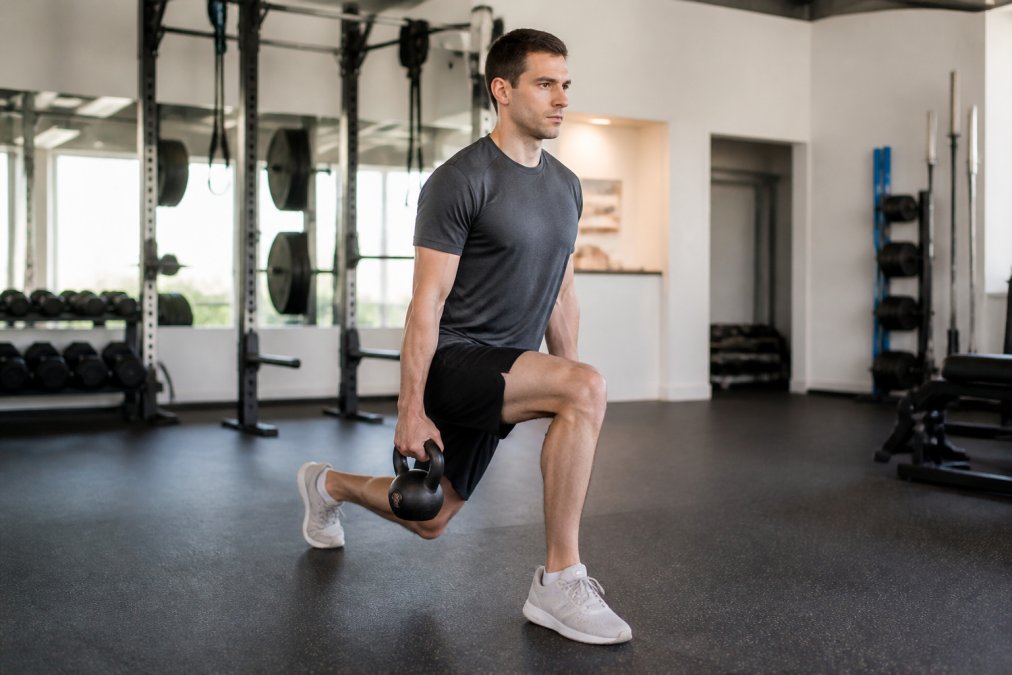
Think of the swing as a kinematic chain. Force starts when your feet push into the ground.
Train the chain from the ground up:
- Split squats and rear-foot-elevated split squats for single-leg strength and balance, your swing is a one-leg-dominant move
- Trap bar deadlifts for the posterior chain (glutes, hamstrings, lower back) with less spinal load than a straight bar
- Rotational core work like cable chops, Pallof presses, and half-kneeling landmine rotations
- Explosive lifts like medicine ball rotational throws and med ball slams for rate of force development
Core Stability and Balance
Core stability lets you rotate fast without losing posture. Balance keeps your swing centered over the ball.
Try these:
- Single-leg stands with eyes closed (30 seconds per side)
- Planks and side planks (hold 30-45 seconds)
- Bird dogs for spinal control (10 reps per side, slow tempo)
- Dead bugs to train anti-extension under breathing
Match the Plan to Your Age and Body
Speed training is not one-size-fits-all. The same program that adds 5 mph for a 25-year-old can wreck a 55-year-old's lower back if the recovery and mobility work are skipped.
- Under 40: You can handle heavier loads and more weekly volume. Two strength days plus two speed days is sustainable.
- 40 to 60: Prioritize mobility and recovery. Reduce heavy lifting to once a week and add a dedicated mobility session. Warm-ups get longer, not shorter.
- 60 and over: Emphasize band work, light medicine balls, and single-leg stability before adding load. Speed gains still come, they just come from efficiency and sequencing rather than raw force.
Mobility Comes Before Power
The Titleist Performance Institute's swing research has long emphasized that mobility and stability come before power. Two restrictions kill swing speed more than weak muscles:
- Tight hips limit how much you can rotate away from the ball, which caps your potential downswing speed
- A stiff thoracic spine forces your lower back to make up the rotation, which is both slow and injury-prone
Step 2: Master Swing Tempo and Rhythm
Tempo is the ratio of your backswing time to your downswing time. A smooth, repeatable tempo produces more consistent speed than a jerky lunge.
Here is a simple tempo drill:
- Make three practice swings at half speed
- Add 10% speed on each rep
- Stop when you feel tension in your arms
- Reset and repeat
Step 3: Use Overspeed Training for Golf to Break Speed Plateaus
Overspeed training for golf uses lighter-than-normal clubs to teach your body to move faster. Your nervous system learns that faster is safe.
The method is simple:
- Swing a light club as fast as you can
- Follow with a normal club
- Then a heavier club
Step 4: How to Use Launch Monitors for Speed Training
A launch monitor turns guesswork into data. It measures clubhead speed, ball speed, smash factor, and swing path. That feedback tells you which changes actually add speed.
To use a launch monitor well:
- Hit 10 baseline shots and record your average clubhead speed
- Change one thing at a time
- Re-measure after each change
- Keep what works, drop what does not
Step 5: Practice Golf Swing Speed Training Drills
Golf swing speed training drills build speed through repetition and intent. Here are four to rotate through:
- Step-through swings: Step forward as you swing to feel weight transfer
- One-arm swings: Builds arm and wrist strength and control
- Heavy club swings: Trains the muscles to handle more load
- Max-effort swings: Five swings at full speed, then full rest
| Drill | What It Trains | Reps | Frequency |
|---|---|---|---|
| Step-through swings | Weight transfer, ground force | 5-8 | 2x per week |
| One-arm swings | Arm and wrist strength | 5 each arm | 2x per week |
| Heavy club swings | Load tolerance | 5-8 | 2x per week |
| Max-effort swings | Raw speed, intent | 5 | 2x per week |
Step 6: Warm Up for Speed and Prevent Injury
Most speed content tells you to warm up and moves on. That is a missed opportunity. A proper warm-up does two jobs: it lowers injury risk and it actually unlocks speed you already have but cannot access cold. This is the pre-round speed activation routine almost no competitor covers.
The 12-Minute Pre-Round Speed Activation
Run this before any speed session or round. Total time: about 12 minutes.
1. Raise (3 minutes)
- Light cardio, brisk walk, bike, or jump rope, until you feel warm but not winded
2. Mobilize (4 minutes)
- Leg swings, front to back and side to side (10 each direction per leg)
- Hip openers, 90/90 hip switches (8 per side)
- Thoracic rotations, open books or seated spine twists (10 per side)
- Wrist and forearm circles (15 seconds each direction)
3. Activate (3 minutes)
- Glute bridges (10 reps, squeeze at the top)
- Banded lateral walks (10 steps each direction)
- Dead bugs (8 per side)
4. Prime (2 minutes)
- Ten practice swings building from half speed to full speed
- Two or three max-intent swings with an overspeed club, then rest
Injury Prevention Rules for Speed Training
High-intensity speed work carries real risk. Two rules cover most of it:
- Never swing max effort cold. Cold muscles and a cold nervous system are how pulled backs and strained wrists happen.
- Never ignore pain. A twinge in your back, wrist, or elbow is a signal to stop, not push through. Speed training is cumulative, one bad session can cost you weeks.
Step 7: Track Your Progress with Data
Data shows whether your training works. Without it, you are guessing.
Track these numbers each week:
- Average clubhead speed
- Ball speed
- Smash factor
- Swing tempo
Quick reference: your speed training week
| Day | Focus | Time |
|---|---|---|
| Monday | Strength and conditioning | 40 min |
| Tuesday | Overspeed and tempo work | 25 min |
| Thursday | Speed drills and launch monitor | 30 min |
| Saturday | Warm-up, full-speed swings, tracking | 30 min |
Frequently Asked Questions
Is 85 mph swing speed slow?
For amateur male golfers, 85 mph is below average. Most male amateurs swing between 90 and 100 mph, while LPGA professionals average around 94 mph. For female amateurs, 85 mph is above average. If you want to add distance, improving your golf swing speed from 85 mph to 95 mph could gain you 20-25 yards off the tee. A launch monitor can show your exact speed and help you track progress.
How can I realistically add 20 yards to my drive?
Adding 20 yards requires a combination of speed and solid contact. Increasing your clubhead speed by 5 mph typically adds about 10-12 yards, and improving smash factor (center-face contact) can add another 5-8 yards. Focus on overspeed training, strength work, and using a launch monitor to optimize your launch conditions. Consistent practice with feedback is key.
What is the 70/30 rule in golf?
The 70/30 rule suggests that 70% of your practice time should be spent on shots inside 100 yards (wedges, putting, chipping), and 30% on full-swing shots. This ratio helps lower scores because most amateur strokes are lost close to the green. However, if your goal is specifically to improve golf swing speed, you may temporarily shift that balance to include more speed-focused work.
Does flexibility play a bigger role than strength in swing speed?
Both matter, but they contribute differently. Flexibility and mobility allow you to make a bigger turn and create a wider swing arc, which can increase clubhead speed. Strength, especially in the core and legs, helps you generate and transfer force. Most golfers benefit from a balanced approach: dynamic stretching before play and strength training 2-3 times per week.
Building real golf swing speed takes patience, a plan, and honest feedback. Open Tee Golf gives you a private, climate-controlled bay with Full Swing simulator data, 24/7 access, and no tee times, so you can train on your own schedule all year. Become a member and turn your practice into measurable distance.