
How Do Competitive Golfers Practice Indoors Effectively?
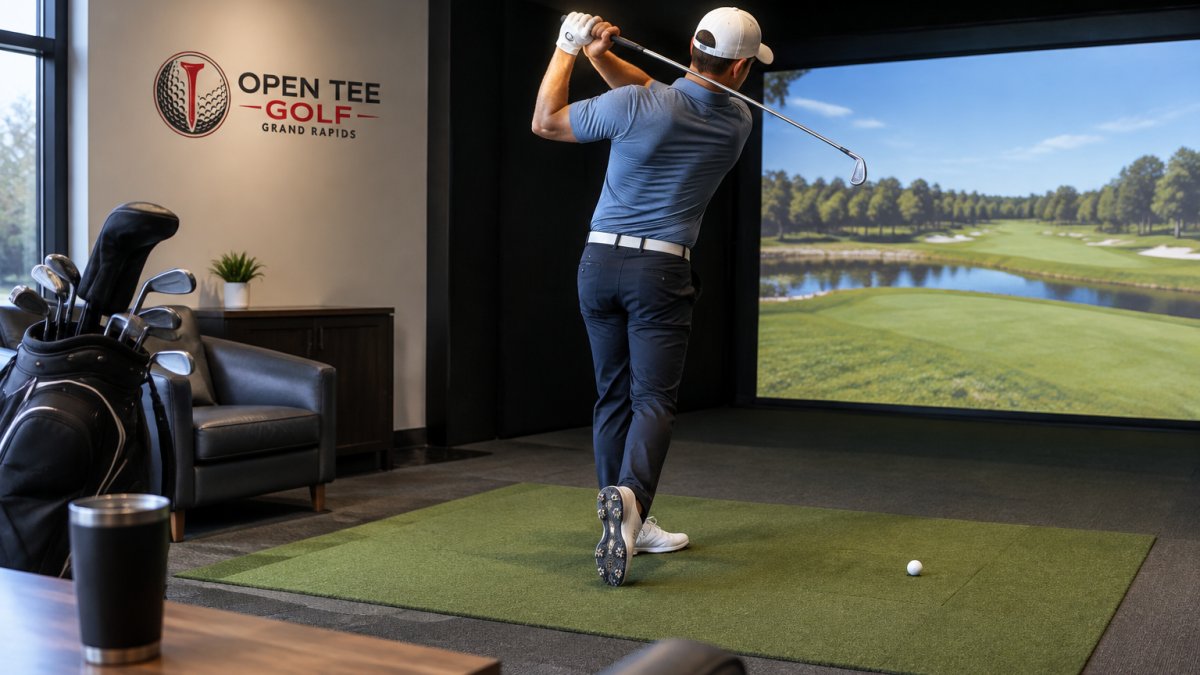
Last Updated: November 12, 2026
Quick Summary
Competitive golfers get the most from indoor golf practice by setting one measurable goal per session, tracking launch monitor data and training in short, frequent blocks. Open Tee Golf offers 24/7 private, climate-controlled bays with Full Swing simulators so players can practice on a consistent schedule.
- Set one measurable goal before every indoor session.
- Warm up for 10 to 15 minutes with short wedges and mid-irons.
- Two focused 45-minute sessions each week often beat one long session.
- Read carry distance, club path and face angle together, not in isolation.
- Open Tee Golf offers 24/7 access to private bays with Full Swing simulators.
Table of Contents
- Why Indoor Golf Practice Matters for Competitive Players
- Building a Golf Simulator Practice Routine That Holds Up Over Time
- High-Level Indoor Golf Practice Drills for Competitive Golfers
- Using Golf Launch Monitor Data to Find and Fix Swing Faults
- Why 24/7 Private Access Makes Consistent Training Possible
- Practicing at Home Without Clubs: What Works and What Doesn't
- Booking Your First Private Session at Open Tee Golf
- Frequently Asked Questions
Why Indoor Golf Practice Matters for Competitive Players
Competitive golfers can no longer rely on the weather to decide when they train. Indoor golf practice gives serious players a controlled environment where every swing is measured and every session can be repeated. At Open Tee Golf, we built our private facility around that idea: consistent work, tracked with precise data, on your own schedule.
Indoor practice removes the guesswork that slows most players down. You see exactly how far the ball carries, how the club path moves, and where the face was pointing at impact. That feedback loop is what separates a practice session from a round of hitting balls with no clear purpose.
Watch out: Practicing without a plan, even with good data, can reinforce the same faults session after session. Set one measurable goal before every visit.
Building a Golf Simulator Practice Routine That Holds Up Over Time
A routine works only when you can repeat it. Start with a warm-up of 10 to 15 minutes, then move through a short block of focused swings with one target metric, such as carry distance or face angle at impact. Finish with a short review of the data before you leave the bay.
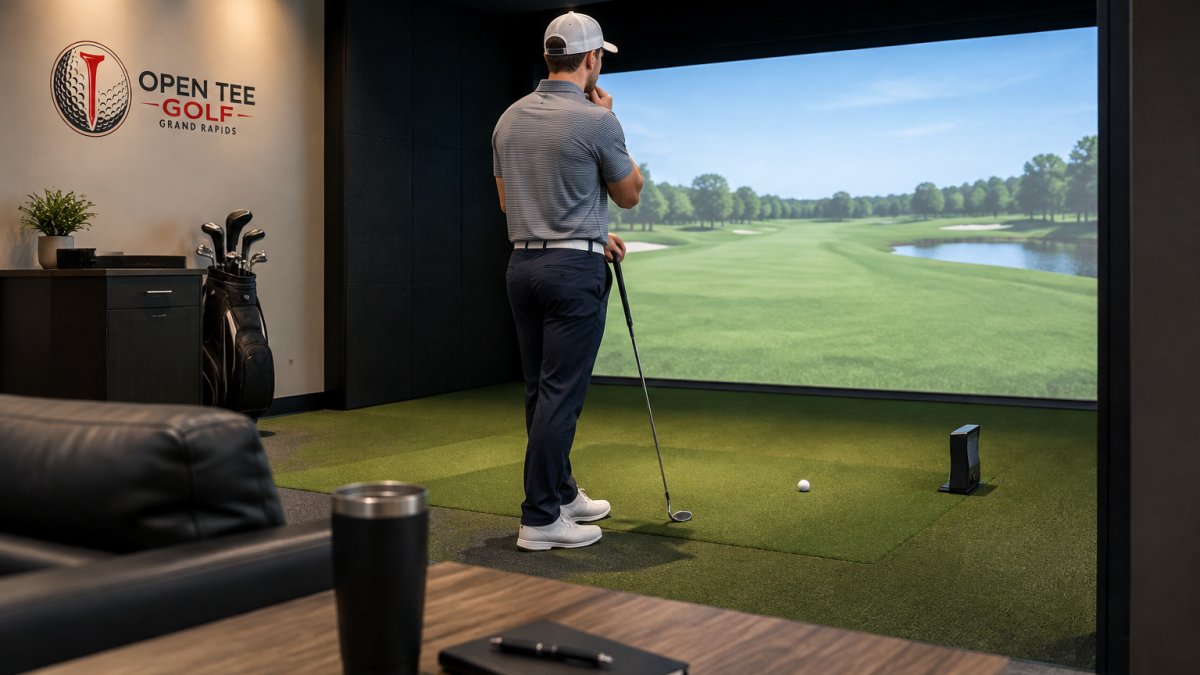
Keep sessions short and frequent. Two focused 45-minute sessions each week often beat one long session that leaves you tired and sloppy. Log the numbers from each visit so you can see trends rather than reacting to a single bad shot.
- Warm up for 10 to 15 minutes with short wedges and mid-irons
- Pick one metric to improve for the session
- Hit in blocks of 10 to 15 shots, then review
- Log carry, club path and face angle after each block
High-Level Indoor Golf Practice Drills for Competitive Golfers
Competitive players need drills that test pressure and precision, not just repetition. Try a distance-control drill: pick three target yardages with your 7-iron, hit five balls at each, and track the spread. Tight groupings tell you that your strike is repeatable under simulated conditions.
A second useful drill is the gate drill for face control. Set virtual targets narrow enough that a half-degree of face error shows up on the screen. Work until you can hit most shots within the target window before moving to the next club.
The third drill is pressure sequencing. Play a nine-shot sequence where each miss adds a penalty shot. This turns practice into a test of composure, which is where many tournament rounds are lost.
Using Golf Launch Monitor Data to Find and Fix Swing Faults
Launch monitor data is most useful when you read it as a set of connected numbers rather than isolated stats. A slice usually shows up as an open face combined with an out-to-in club path, so checking one metric alone can send you in the wrong direction.
Reading Carry Distance, Club Path and Face Angle
Carry distance tells you what the ball actually flew. Club path shows the direction the club was moving at impact, and face angle shows where the clubface pointed. Together, these three numbers explain most of the shot shape you see.
If your carry distance is consistent but your face angle swings widely from shot to shot, focus on grip and setup before you touch your swing path. Fixing the wrong variable wastes time and can create new faults.
The three numbers that explain most shot shape, and what each one tells you:
| Metric | What it shows | Use it to |
|---|---|---|
| Carry distance | How far the ball actually flew | Judge consistency of strike |
| Club path | Direction the club moved at impact | Diagnose out-to-in or in-to-out swings |
| Face angle | Where the clubface pointed at impact | Identify the main cause of shot shape |
Why 24/7 Private Access Makes Consistent Training Possible
Consistency is the real advantage for competitive players, and it depends on access. At Open Tee Golf, members get 24/7 access to private, climate-controlled bays with Full Swing simulators. You can train at 6 a.m. before work or late at night after a shift, without waiting for a tee time or sharing space with a crowd.
Private bays also let you practice the same way every time. The room is the same, and the data is recorded the same way. Over months, that repeatability makes trends in your numbers easier to trust.
- Train whenever your schedule allows, day or night
- No tee times or waiting for a free bay
- Private space for focused, distraction-free reps
- Year-round practice regardless of weather
Practicing at Home Without Clubs: What Works and What Doesn't
Many players try to keep their skills sharp at home without a club. Some movement drills, such as balance work, tempo drills with a weighted training stick, and grip pressure exercises, can help between sessions. These drills build body awareness but cannot show you ball flight or face angle.
Other players rely on this kind of home work alone and wonder why their scores do not improve. Home drills work best as a supplement to measured practice, not a replacement. Use them to reinforce what you learned from the data.
Booking Your First Private Session at Open Tee Golf
Your first session is the best time to set a baseline. Arrive with one goal in mind, such as tightening your 7-iron carry window or reducing your face-angle spread. Ask our team about setting up the simulator so the data reflects how you play.
Visit Open Tee Golf in Wyoming, MI to see the private bays and ask about membership options. For current rates and availability, check the website or contact us directly.
To start, choose your Open Tee Golf membership and compare the options on our website. If you want to see the facility first, visit Open Tee Golf to schedule a tour. Our team can answer questions about booking and private room setup.
Competitive golfers who train with measured feedback, a repeatable routine and 24/7 private access tend to build the consistency that wins events. Open Tee Golf is built to support that goal. Get started with Open Tee Golf and start tracking your progress from your first session.
Frequently Asked Questions
How long should an indoor golf practice session be?
Most competitive players get the most from indoor golf practice sessions lasting 60 to 90 minutes. That window is long enough to warm up, run a structured drill block, and review launch monitor data without fatigue setting in and reinforcing bad habits. Shorter sessions of 30 to 45 minutes work well on busy days, especially when you focus on one swing fault. Because Open Tee Golf is open 24/7 in private bays, you can schedule sessions around your training plan rather than around tee times or crowds.
Can you practice golf indoors without hitting a ball?
Yes. You can rehearse setup, posture, tempo, and takeaway without striking a ball, which is useful for checking alignment and reinforcing movement patterns. Many golfers use slow-motion swings or alignment-stick drills before hitting. For competitive players, though, the most valuable indoor practice includes impact, because launch monitor data only shows results when the ball is struck. Pairing no-ball rehearsal with full swings in a private simulator bay gives you both movement quality and measurable feedback.
How do you use launch monitor data to improve your golf game?
Start by choosing two or three metrics that matter most for your game, such as club path, face angle, and carry distance. Track them across a set of shots, then look for patterns rather than reacting to single outliers. A consistent window of face angle in the same direction usually points to a specific fault you can drill. Repeat the same test each week so you can measure whether your changes are holding. At Open Tee Golf, members have access to Full Swing simulator data that makes these comparisons straightforward.
What should a competitive golfer work on during an indoor practice session?
Prioritize the areas that most affect your scoring: distance control with your scoring clubs, directional accuracy with the driver, and consistency under pressure. Use a warm-up, then a focused drill block on your weakest area, followed by a short test session to measure progress. Avoid spending the entire session hitting driver if your data shows your wedge distances are inconsistent. The private setting at Open Tee Golf lets you repeat the same drill without worrying about other players waiting.
