
Is Indoor Golf Worth It? A 2026 Analysis
Table of Contents
- Is Indoor Golf Worth It? The Core Question
- Golf Simulator vs Driving Range: What's the Real Difference
- Benefits of Indoor Golf Practice for Your Game
- Indoor Golf Membership Cost: What You Actually Pay
- Year-Round Access and Convenience Factor
- Indoor Golf for Different Golfer Types
- The Verdict: When Indoor Golf Makes Financial Sense
- Frequently Asked Questions
Last Updated: September 28, 2026
Is Indoor Golf Worth It? The Core Question
The question "is indoor golf worth it" doesn't have a simple yes or no answer. It depends on who you are, how often you play, and what you value most. Some golfers find it transforms their game. Others see it as an expensive convenience they rarely use.
Here's what matters: indoor golf solves real problems for specific golfers. If you live in a climate with long winters, struggle to find tee times, or want to track your swing data, the value proposition shifts dramatically. At Open Tee Golf in Wyoming, we've seen members from all backgrounds discover that year-round, private access changes how they approach the game.
The core question isn't whether indoor golf is worth it in general. It's whether it's worth it for you.
Golf Simulator vs Driving Range: What's the Real Difference
A golf simulator and a driving range serve different purposes, even though both let you hit golf balls. Understanding this distinction is crucial to deciding if indoor golf makes sense for your game.
A driving range is straightforward. You hit balls into an open field. You get feedback from watching the ball flight. That's valuable, but it's limited. You can't play a full course. You can't track precise data about club head speed, launch angle, or spin rate. You hit the same types of shots repeatedly.
A golf simulator is something else entirely. It recreates full golf courses on a screen. You hit a ball into a net or mat, and sensors capture exactly what your club did. The simulator shows you where your ball would have landed on a real course. You play 18 holes. You compete in tournaments. You track every metric that matters to your swing.
The key differences break down like this:
- Course play: Driving ranges offer only practice. Simulators let you play full rounds on real courses.
- Data tracking: Ranges give you visual feedback. Simulators measure club head speed, launch angle, spin rate, and shot dispersion.
- Variety: Ranges limit you to hitting balls. Simulators offer hundreds of courses and competitive formats.
- Weather: Ranges close in bad weather. Simulators work year-round in climate-controlled comfort.
- Privacy: Ranges are public. Indoor simulators at facilities like Open Tee Golf offer completely private bays.
For serious golfers, the simulator advantage is clear. For casual hitters, a driving range might be enough.
Benefits of Indoor Golf Practice for Your Game
Indoor golf practice delivers specific, measurable improvements that outdoor golf alone cannot match. The benefits extend beyond convenience.
Precision data changes how you practice. When you see your club head speed, launch angle, and spin rate after every shot, you stop guessing. You know exactly what you're doing right and wrong. This feedback loop accelerates improvement. Golfers who practice with data-tracked simulators refine their mechanics faster than those who rely on feel alone.
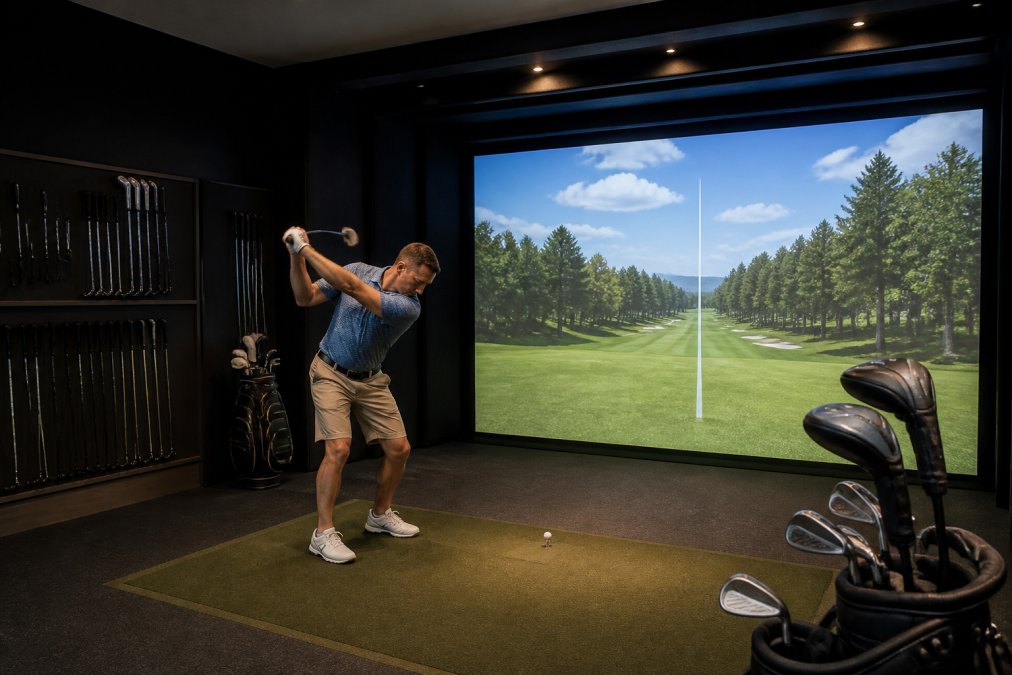
Year-round access keeps your game sharp. In regions with cold winters, outdoor golf becomes impossible for months. Your swing deteriorates during the off-season. Indoor facilities solve this completely. You can practice and play every single day, regardless of weather or season. Competitive golfers maintain their edge. Casual players stay engaged.
Private bays eliminate distractions. Public ranges are crowded. You wait for bays. You deal with noise and movement around you. Private simulator bays at facilities like Open Tee Golf remove all of that. You focus entirely on your swing. You can practice at 10 p.m. if you want. You can bring a coach to analyze your mechanics. You can work on specific shots without feeling rushed.
Competitive play happens indoors. Simulators host tournaments, leagues, and head-to-head matches. You can compete against players worldwide. You can track your scores across dozens of courses. This competitive element keeps golfers motivated and engaged in ways that practice alone cannot.
Indoor Golf Membership Cost: What You Actually Pay
The cost of an indoor golf membership varies based on facility and membership tier. Open Tee Golf offers flexible membership options designed for different usage levels. For specific pricing and current membership packages, visit Open Tee Golf's website or contact the facility directly to get a quote tailored to your needs.
When evaluating cost, consider what you're actually paying for:
- Unlimited access: Most memberships include unlimited facility hours. Some offer 24/7 access.
- Simulator technology: Full Swing simulators represent a significant investment. Newer technology costs more to maintain.
- Private bay rental: A dedicated bay is yours alone. No waiting. No sharing equipment.
- Climate control: Year-round comfort requires heating and cooling infrastructure.
- Courses and updates: Access to hundreds of courses and regular software updates.
The real question isn't the price. It's the cost per use. If you visit twice a month, the monthly cost seems high. If you visit twice a week, it becomes reasonable. If you visit daily, it becomes a bargain.
Many golfers discover that membership pays for itself through reduced green fees. When you stop paying for tee times and instead practice indoors, the math shifts quickly.
Year-Round Access and Convenience Factor
Year-round access is the biggest advantage indoor golf offers. In Wyoming and the broader region, winters eliminate outdoor golf for months. Spring and fall weather can be unpredictable. Rain, wind, and cold make practice unpleasant.
An indoor facility changes this completely. You can practice in January as easily as July. You don't cancel plans because of weather. You don't lose momentum during the off-season.
Convenience extends beyond weather. Shift workers and busy professionals struggle with outdoor golf. Tee times require advance booking. Courses have set hours. Open Tee Golf operates 24/7. If you work nights, you can practice at 2 a.m. If you have an hour between meetings, you can get a quick session in. This flexibility is impossible at traditional courses.
No tee time hassles. Traditional golf requires reservations. Peak times fill up weeks in advance. You compete for limited slots. Indoor simulators eliminate this friction. You walk in when you want. You play immediately. You use as much time as you need.
Travel time matters. If you live 30 minutes from the nearest course, the round-trip drive eats into your time. An indoor facility closer to home saves hours monthly. This convenience compounds over time.
Indoor Golf for Different Golfer Types
Indoor golf appeals to different people for different reasons. Understanding which type you are helps clarify the value.
Competitive golfers benefit most from simulators. The data tracking, tournament formats, and year-round practice create an ideal environment for improvement. If you're serious about lowering your handicap, indoor golf accelerates progress.
Casual players enjoy simulators for entertainment and social play. You can bring friends or family. You can play courses you've never visited. The experience feels premium. The private bay setting makes it special. Cost becomes less important when the value is social and recreational.
Shift workers and busy professionals find simulators essential. You can't work around tee time schedules. Indoor facilities with 24/7 access solve this problem entirely. You practice on your schedule, not the course's schedule.
Couples and groups use indoor golf for date nights and team building. The private bay setting is intimate and comfortable. You can spend an hour or three hours. You can bring food and drinks. It feels like a private club experience.
Beginners sometimes worry that simulators are too advanced. This concern is misplaced. Simulators actually help beginners learn faster. The data shows you exactly what's happening with your swing. You can take lessons in a private bay. You can practice without feeling self-conscious around experienced golfers.
Off-season athletes use indoor golf to maintain fitness and skills during winter. Skiers, runners, and outdoor enthusiasts stay engaged with golf year-round instead of abandoning it for six months.
The Verdict: When Indoor Golf Makes Financial Sense
Indoor golf is worth it when three conditions align: you have access to a quality facility, you'll use it regularly, and the cost fits your budget.
Quality matters. Not all simulators are equal. Full Swing technology at Open Tee Golf delivers military-grade accuracy. Older simulators feel glitchy and unreliable. If you're paying for membership, you want equipment that works perfectly every time.
Usage drives value. A membership that costs $150 monthly is expensive if you visit twice. It's a bargain if you visit twice weekly. Calculate your likely usage honestly. Be realistic about how often you'll actually go.
Budget alignment is essential. Even a great facility at a fair price isn't worth it if you can't comfortably afford it. The best golf improvement comes from consistent practice, and you can't be consistent if you're stressed about cost.
For most serious golfers in Wyoming and the surrounding area, indoor golf becomes worth it when the facility offers year-round 24/7 access, private bays, and reliable simulator technology. Open Tee Golf checks all three boxes.
Frequently Asked Questions
Is indoor golf as good as real golf for improving your swing?
Indoor golf simulators provide precision data that outdoor ranges cannot match. Full Swing technology captures ball flight, launch angle, and spin rate with military-grade accuracy. This data helps you identify swing flaws and track improvement over time. However, simulators don't replicate wind, elevation changes, or the physical demands of walking a course. For serious practice and swing mechanics, indoor golf is superior. For course management and mental toughness, outdoor play remains essential. Most golfers benefit from combining both.
How much does an indoor golf membership typically cost?
Membership pricing depends on frequency of use, membership tier, and facility location. Contact Open Tee Golf directly for current pricing and membership options that fit your budget and practice schedule.
Can indoor golf actually help lower your handicap?
Yes, if you use it strategically. Consistent practice with precise swing data accelerates improvement. Many competitive golfers use indoor simulators during off-season months to maintain sharpness and refine mechanics. The key is focused practice, working on specific swing issues identified by simulator data, rather than casual play. Beginners and intermediate players see faster improvement because they have more fundamental areas to develop. Advanced players use it for fine-tuning and maintaining consistency year-round.
Is indoor golf worth it if I only practice a few times per month?
It depends on your goals and the membership structure. However, if your goal is measurable improvement, even occasional access with precision data outperforms sporadic range visits. The real value emerges when you commit to consistent practice, weekly or more, where membership costs become justified by the data feedback and convenience. Evaluate membership vs. pay-per-play based on your realistic usage frequency.