
7 Benefits of Overspeed Training for Amateur Golfers
Last Updated: November 17, 2026
Quick Summary
Overspeed training means swinging a club faster than your normal tempo, often with lighter or heavier implements, so your body learns to move at higher speeds. It can help amateur golfers build a faster, more athletic swing, but gains come gradually and only transfer to the course when contact stays solid.
- Most amateur golfers swing well below their potential speed, and overspeed work pushes that ceiling higher.
- Set a baseline in your first session and repeat the same measurements every two weeks.
- Watch smash factor: rising speed with falling smash factor means you are trading control for velocity.
- Change only one variable per two-week block, adding either speed or volume, not both.
- Do a full warm-up and screen for pain or limited mobility before starting any session.
Table of Contents
- What Overspeed Training Is and How It Works
- How Overspeed Training May Increase Swing Speed
- Benefits and Limitations for Amateur Golfers
- Golf Speed Training Protocol for Beginners
- Golf Speed Training at Home vs. a Private Simulator Bay
- Overspeed Training Equipment and How FullSwing Tracks Your Speed
- Start Your Overspeed Sessions at Open Tee Golf
- Frequently Asked Questions
What Overspeed Training Is and How It Works
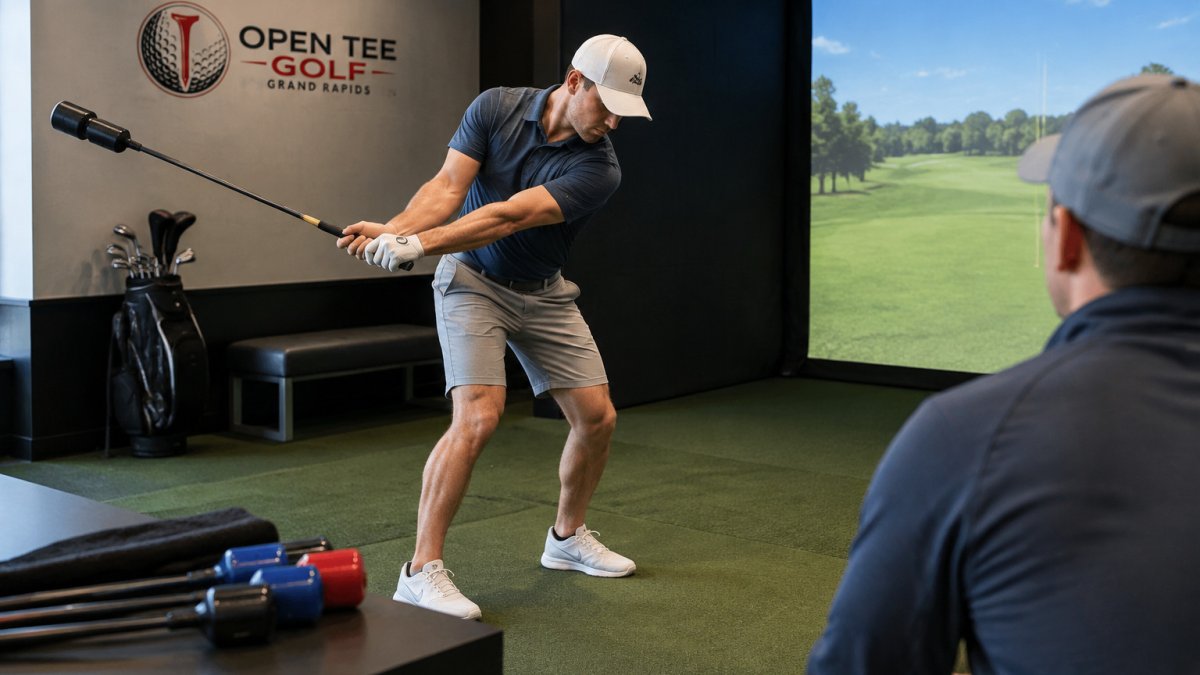
Overspeed training means swinging a club faster than you normally would, using lighter or heavier implements, so your body learns to move at higher speeds. The idea is simple.
Most amateur golfers swing well below their potential speed. Overspeed work pushes that ceiling higher. Training sessions often pair fast swings with a normal club to help the movement feel familiar.
Key points about the method:
- It uses swings faster than your normal tempo
- It often mixes lighter and heavier implements
- It works best as a short, focused part of practice
How Overspeed Training May Increase Swing Speed
Swing speed depends on how well your body sequences its movements, not only on how hard you push. Overspeed training aims to teach your hips, torso, arms, and hands to fire in the right order at higher speeds.
Whether faster practice swings turn into real distance on the course depends on technique, strength, and consistency.
Nervous System Adaptation and Muscle Recruitment
Your nervous system controls how many muscle fibers you use and how quickly they fire. Fast swings challenge that system to recruit more muscle, and repeated practice can make the pattern more efficient over time.
Think of it like a dimmer switch. The more often you turn the switch to a higher setting, the easier it becomes to hold that setting. This adaptation takes repetition and patience.
Potential Distance Gains and Realistic Expectations
Results vary widely. Your starting strength, flexibility, technique, and practice schedule all play a role.
Set realistic goals. Gains are usually gradual, and a faster swing only helps if you can still control the strike.
Benefits and Limitations for Amateur Golfers
Amateur golfers are a different audience. You may play once a week, practice in short windows, and have a swing that still has some rough edges. That changes which benefits are realistic and which limitations actually matter.
What amateur golfers can realistically expect
Practice swings are unconstrained; full swings require you to square the face and find the center of the club. Speed gains in practice do not automatically carry over to the on-course number, which depends on contact staying solid.
Benefits that show up for most recreational players:
- A faster-feeling, more athletic swing during practice and warm-ups
- Better body awareness, especially around hip and torso sequencing
- A measurable baseline you can track session to session instead of guessing
Limitations that matter more for amateurs than for tour players:
- Speed gains do not automatically transfer to the course if your face control or low-point consistency is still developing
- A faster swing amplifies an existing slice or hook rather than fixing it
- Recovery takes longer than most amateurs expect, especially if you are also lifting or playing weekly
Who should avoid or modify overspeed training
Overspeed training is a high-effort, high-velocity activity, and it is not appropriate for everyone without modification.
Screen yourself before your first session:
- Current pain: Any sharp pain in the back, shoulder, elbow, or wrist means stop and get it evaluated before starting. Do not train through it.
- Recent injury or surgery: Wait for clearance from your physician or physical therapist, then start with normal-speed swings only.
- Limited mobility: If you cannot comfortably make a full turn or get your arms overhead, spend two to three weeks on mobility first. Fast swings into a restricted range are a common way amateurs get hurt.
A simple rule: if you would not sprint at full effort without warming up, do not swing at full overspeed without warming up either.
How to measure whether it is working
Do not rely on feel alone. Establish a baseline in your first session and repeat the same measurement every two weeks.
- Clubhead speed: Record your fastest three normal swings with your driver and take the average.
- Ball speed: Record ball speed on ten solid strikes and note the average, not the single best.
- Smash factor: Divide ball speed by clubhead speed. If speed is rising but smash factor is falling, you are trading control for velocity.
At Open Tee Golf, our FullSwing-equipped private bays capture these numbers, so you can compare sessions without setting up extra equipment.
Watch out: chasing a new personal-best clubhead speed every session is a common way amateurs stall out. Progress is measured across weeks, not within a single bucket of balls.
Golf Speed Training Protocol for Beginners
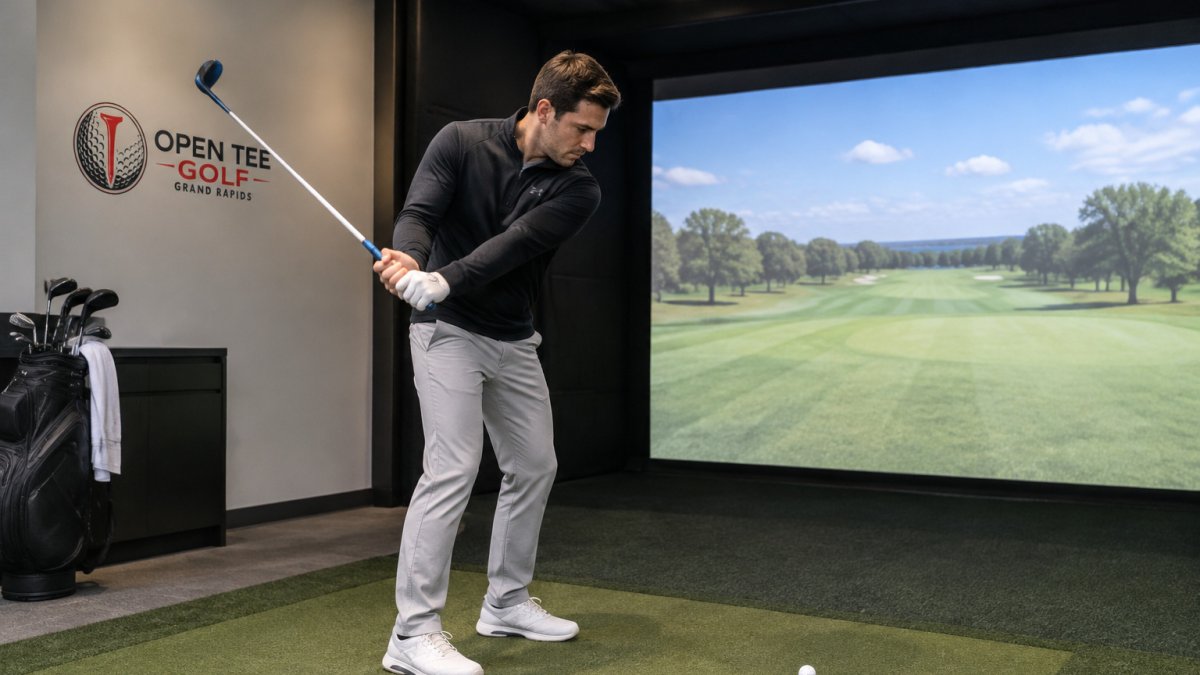
A beginner protocol should be boring on purpose. The goal in the first month is not maximum speed; it is teaching your body to move fast while staying balanced, then proving you can still hit the ball where you aim. Here is a structure you can run in a private simulator bay or at home.
Before you start: a two-minute readiness check
Run through this before every session, not just the first one.
- Pain check: Any sharp pain in the back, shoulder, elbow, or wrist? Stop and address it before training.
- Mobility check: Can you turn your shoulders roughly 90 degrees with a club across your chest without your lower body collapsing? Can you get your arms overhead without arching your back?
- Balance check: Can you stand on one foot for 20 seconds without significant wobble? Fast swings require you to decelerate, and balance is part of that.
- Recovery check: Are you still sore from your last session or a round of golf? If yes, take an extra rest day.
If you fail the pain or mobility check, spend the session on mobility and normal-speed swings instead.
The session structure
A beginner session should run 20 to 30 minutes, including warm-up. Here is a repeatable template.
- Warm up for 8 to 10 minutes. Light cardio, shoulder and hip circles, torso rotations, and easy half-speed swings with a mid-iron. Do not skip this.
- Hit 10 to 15 normal swings with a ball. Use your driver or a mid-iron and focus on solid contact at your usual tempo. This establishes your baseline for the day.
- Overspeed block: 3 sets of 5 swings. Use a lighter implement or a speed-training club. Swing at roughly 90 to 100 percent effort while staying balanced. Rest 60 to 90 seconds between sets.
- Return to a normal club: 10 swings with a ball. Notice whether your tempo feels smoother or more rushed. This is where transfer starts.
- Cool down with 5 easy swings and light stretching. Give your nervous system a clear signal that the fast work is over.
- Log your numbers. Record average clubhead speed, average ball speed, and dispersion for the session.
Progression rules
Do not add speed and volume at the same time. Pick one variable per two-week block.
- Weeks 1-2: Three sets of five overspeed swings, two sessions per week. Focus on balance and finish position.
- Weeks 3-4: Add one set (four sets of five) if you have no soreness and your dispersion has not widened.
- Weeks 5-6: Add a third weekly session, or increase effort slightly, but not both.
Translating faster swings into on-course performance
This is the step most beginners skip, and it is why speed gains sometimes disappear on the course.
- Hit balls at your new speed, not just your old speed. After the overspeed block, hit 10 full swings with a ball at the faster tempo and check where the ball goes.
- Practice a controlled fast swing. Aim for a swing that is faster than your old normal but still balanced at the finish. If you cannot hold your finish for a beat, you are over-swinging.
- Use a target, not just a launch monitor. Pick a fairway or green and count how many of ten shots land in your acceptable window. Speed without a target is just noise.
- Take it to the course gradually. Play a few holes at your new speed before using it on every tee shot. Many amateurs find they need a round or two to trust it.
At Open Tee Golf, our 24/7 private bays let you run this exact session on your own schedule, with FullSwing tracking your club and ball data so you can see whether the faster swing is still producing a playable ball flight.
Watch out: adding a third session and a higher effort level in the same week is the most common way beginners get sore and lose a month of progress. Change one variable at a time.
Golf Speed Training at Home vs. a Private Simulator Bay
A private simulator bay offers a controlled, private space for focused practice.
| Option | Best For | Main Drawback |
|---|---|---|
| Home practice | Daily stretching and drills | Limited data and space |
| Private simulator bay | Tracked, focused sessions | Requires a membership or visit |
Many golfers use both. Home drills keep the movement fresh, while simulator sessions provide the measurements you need to see progress. If you're planning ahead, a structured winter practice routine lays out indoor drills and a weekly schedule you can follow in either setting. Our guide to the simulator features beginners should prioritize explains which numbers matter most when you're starting out.
Overspeed Training Equipment and How FullSwing Tracks Your Speed
Overspeed sessions rely on accurate measurement. At Open Tee Golf, our private bays use FullSwing simulator technology, which tracks your swing and ball flight data. That gives you numbers to compare session to session, so you can see whether your changes are working.
FullSwing's tracking captures swing and ball flight data, which you can use to compare sessions. For a deeper look at the technology, see our simulator page.
Start Your Overspeed Sessions at Open Tee Golf
Open Tee Golf is a private indoor club in Wyoming, MI, with 24/7 access, so you can train on your own schedule. Our fully private bays offer climate-controlled comfort year-round and no tee times to wait for. Choose the membership that fits your schedule and start tracking your progress.
For a beginner-friendly plan, read our guide to improving swing speed with seven steps. It pairs well with a simulator session.
Frequently Asked Questions
What is overspeed training in golf?
Overspeed training is a practice method where you swing lighter or specially designed implements at a speed faster than your normal swing, or swing a standard club with intent to move at higher velocity. The goal is to train the nervous system and muscles to produce faster movement, which may carry over to your regular swing. It is typically done in short sets with full recovery between swings, and it works best as a supplement to your normal technique practice rather than a replacement for it.
Does overspeed training increase golf swing speed?
Some golfers see gains in clubhead speed after a structured overspeed training block, but results vary with age, fitness, technique, and consistency. Gains are generally modest and depend on training regularly over weeks rather than a single session. Tracking your speed with a simulator such as FullSwing lets you measure your own baseline and progress rather than relying on general claims. Pair the training with good sequencing and mobility work for the best chance of carrying speed onto the course.
Is overspeed training safe for beginner golfers?
Overspeed training can be appropriate for beginners when it starts with a proper warm-up, moderate sets, and adequate rest. Beginners should first build basic swing mechanics and fitness, because fast swings with poor technique increase the risk of strain. Golfers with shoulder, back, or other joint problems, or anyone with a medical condition, should check with a qualified professional before starting. Stop any drill that causes pain rather than fatigue.
Can you do golf speed training at home?
Yes, golf speed training at home is possible with a lighter or heavier training club, an open space, and a clear warm-up routine. Home practice is convenient, but it is harder to measure whether your speed is improving. A private indoor bay with simulator technology at Open Tee Golf, open 24/7, makes it easier to track ball speed and clubhead data session by session, so you can see whether your training is working.
